Los Angeles
House of LeavesLos Angeles is the restless urban environment that frames Johnny Truant’s early life and his entry into the mystery surrounding Zampanò. The city appears not as a stable home but as a shifting network of apartments, couches, tattoo shops, bars, clubs, and late-night roads, a place where instability becomes ordinary and where Lude’s effortless social knowledge contrasts with Johnny’s unsettled search for something he cannot yet name.
Setting and Precarious Arrival
Los Angeles first emerges through Johnny’s housing crisis. After a confrontation with a landlord who had become convinced that he was Charles de Gaulle, Johnny was evicted and began moving from couch to couch, traveling between Santa Monica and Silverlake while looking for an apartment. The landlord later burned the building to the ground and told police that a 757 had crashed into it, turning the city’s already unstable domestic world into an absurd scene of literal destruction. Johnny eventually found a studio in Hollywood and resumed a numbing routine as an apprentice at a tattoo shop.
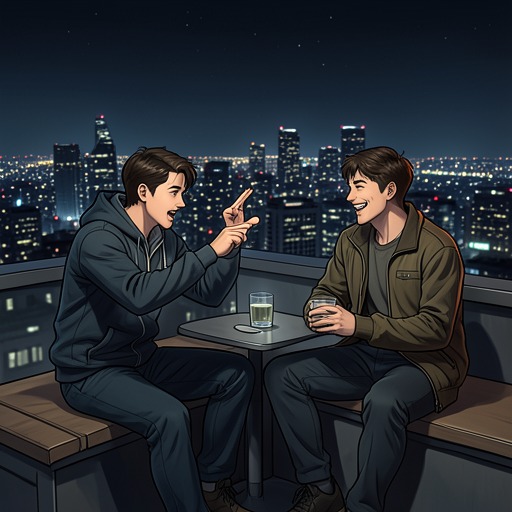
The city’s atmosphere at the end of 1996 is marked by cold nights, failed romantic attachments, and aimless motion. Johnny was recovering from Clara English’s rejection when he redirected his devotion toward a stripper with Thumper tattooed beneath her G-string. On the last hours of the year, he and Lude remained alone, scouting for new bars and new faces, driving recklessly through the canyons, and talking toward the midnight sky without managing to calm it. Los Angeles therefore functions as both playground and pressure chamber: its nightlife offers movement without resolution, and its apparent freedom coexists with emotional and material drift.
Social Geography and Nightlife
Lude possesses an intimate command of Los Angeles that Johnny does not share. He knows every bar, club, and gatekeeper, along with the drinks and addresses that make the city navigable after dark. More significantly, he claims to recognize which women come merely to talk and which are seeking something more sexually charged, a distinction that suits his ambitions and keeps him surrounded by attractive women. His work as a hair stylist and photographer reinforces that social position, since beauty and the people who maintain it draw toward him.
Johnny and Lude have spent roughly two years wandering throughout the city’s late hours. Their companionship depends partly on contrast: both appreciate Los Angeles’s sad taste and nocturnal energy, but Lude wants more money, better parties, and prettier women, while Johnny wants an unnamed alternative. Johnny can describe that desire only through qualities rather than a destination: it feels roomy, is drenched in sunlight, and is weightless, yet it is not cheap. Los Angeles thus becomes the negative space around an imagined elsewhere, a city whose crowded pleasures sharpen Johnny’s sense that his real objective lies beyond ordinary nightlife.
The City and Zampanò’s Death
Los Angeles also supplies the immediate circumstances through which Johnny encounters the old man later identified as Zampanò. While Johnny was living precariously and searching for housing, Lude told him about an elderly man in his building who lived in a first-floor apartment overlooking a wide, overgrown courtyard. The old man had said that he would die soon. Johnny initially treated the report as one of Lude’s exaggerations, although the prediction remained difficult to forget. At the end of that year, the old man died, and the event transformed an ordinary Los Angeles acquaintance into the beginning of Johnny’s involvement with the dead man’s papers.
Zampanò’s apartment presents a stark counter-image to the city’s illuminated nightlife. It contains unused candles, no clocks, very few light bulbs, and pale books, including a large proportion written in Braille. Zampanò had been blind since the mid-1950s, yet his work concerned light, film, photography, and seeing. Readers from community centers, the Braille Institute, and nearby universities had visited him during the day, but none of those consulted by Johnny claimed to know him well. The apartment’s physical darkness therefore gathers together Los Angeles’s larger contradictions: a city associated with spectacle and visual culture contains, within one of its buildings, a secluded intellectual life organized around blindness and mediated reading.
Narrative Significance
Los Angeles is significant because it places Johnny at the intersection of mobility and enclosure. He moves through a broad metropolitan landscape—Santa Monica, Silverlake, Hollywood, the canyons, and the city’s bars—yet his movement does not produce belonging. Instead, the city’s unstable apartments and repetitive nights prepare him to recognize another form of disorientation in Zampanò’s sealed domestic world.
The setting also establishes a contrast between two ways of knowing the city. Lude knows Los Angeles practically and socially: its addresses, drinks, entrances, gatekeepers, and erotic possibilities. Johnny knows it as an atmosphere of exhaustion, disappointment, and incomplete desire. That difference gives the city a double narrative function. It is the concrete place where friendship, work, housing, and nightlife occur, but it is also the threshold through which Johnny passes from ordinary urban wandering into the darker and less legible world opened by Zampanò’s death.